And we're back. After a very very long break, No U Turns is back on the interweb. During this long period of meditative transition, NUTA will be going through a small but necessary surgical procedure. While NUTA will not lose it's intended contextual nature, it will accommodate itself to offer better content and enhance it's visual appeal. With this in mind, we present the following schedule:
Mondays: Don't Turn that page: Authors and Books
Tuesdays: Turn the Music Up (kind of self explanatory)
Wednesdays: Read This Blog Dude.
Thursdays: In the Eye of the Beholder, artistic considerations.
Fridays: What a Cliche! A look at popular culture
Saturdays: The Chatterbox Room, a weekly discussion of fresh topics
Sunday: And on the 7th Day he rested, views on religion and spirituality
This said, NUTA's goal is to increase it's readership from 4 (thanks Felix, Amaru and those two other icons without pictures in them) people to about 100 by the end of September, however this will not be possible without the help of... well you.
Ok, so enough self therapy and let's get to work!
NUTA

Friday, August 20, 2010

Thursday, March 25, 2010
Food for your mind
Here are two great podcasts I recommend to anyone interested in listening to some fresh alternatives to the usual chatter on Public Radio.
The first is a gem of a podcast called Entitled Opinions hosted by Robert Harrison, professor of Italian Literature at Stanford and a scholar on Dante. If you are familiar with Fresh Air on NPR and have a tendency toward listening to a host interviewing of bevy of personalities, this is the equivalent of Fresh Air for the literati crowd. His Q&A's with contemporary thinkers, writers and intellectuals range from energetic debates on French Existentialism to Irish Poetry, American Fiction and Historical Theology. He is completely informative, with a full depth of ideas and gravitas on most subjects that he covers. While the topics can somewhat dwell a bit too long on academic lexicon for the most part if you are interested in energetic and thoughtful conversation this is the podcast for you.
The other one, a bit more known and recently profiled on a New York newspaper is the curiously wonderful In Our Time hosted by the legendary British broadcaster Melvyn Bragg. Most programmes feature a round table of experts discussing topics in themes ranging in Science, Arts, History, Religion and Contemporary Issues. Bragg, who is an Oxford man is usually surrounded by fellow Oxford scholars who with their expertise dissect a conversation so throughly that you will learn something new in every podcast, even in topics that perhaps you knew most about. I've been a listener of this pod for about two years and in the spirit of the old cliche, it never gets old.
Here are two podcasts I recommend from each program. Click on the title of the podcasts to access their websites and of course both podcast are available on Itunes.
Entitled Opinions:
Tobias Wolff on American Fiction
A conversation on Human Rights
In Our Time:
The History of History: How the writing of history through the years
Chance and Design: Exploring questions and theories of a grand design in the Universe.
-NUTA
The first is a gem of a podcast called Entitled Opinions hosted by Robert Harrison, professor of Italian Literature at Stanford and a scholar on Dante. If you are familiar with Fresh Air on NPR and have a tendency toward listening to a host interviewing of bevy of personalities, this is the equivalent of Fresh Air for the literati crowd. His Q&A's with contemporary thinkers, writers and intellectuals range from energetic debates on French Existentialism to Irish Poetry, American Fiction and Historical Theology. He is completely informative, with a full depth of ideas and gravitas on most subjects that he covers. While the topics can somewhat dwell a bit too long on academic lexicon for the most part if you are interested in energetic and thoughtful conversation this is the podcast for you.
The other one, a bit more known and recently profiled on a New York newspaper is the curiously wonderful In Our Time hosted by the legendary British broadcaster Melvyn Bragg. Most programmes feature a round table of experts discussing topics in themes ranging in Science, Arts, History, Religion and Contemporary Issues. Bragg, who is an Oxford man is usually surrounded by fellow Oxford scholars who with their expertise dissect a conversation so throughly that you will learn something new in every podcast, even in topics that perhaps you knew most about. I've been a listener of this pod for about two years and in the spirit of the old cliche, it never gets old.
Here are two podcasts I recommend from each program. Click on the title of the podcasts to access their websites and of course both podcast are available on Itunes.
Entitled Opinions:
Tobias Wolff on American Fiction
A conversation on Human Rights
In Our Time:
The History of History: How the writing of history through the years
Chance and Design: Exploring questions and theories of a grand design in the Universe.
-NUTA
Wednesday, March 24, 2010
A bit of local genius from a great mentor
Hello everyone, after a brief interlude for some reflection and redirection to my very young blog, No U Turs Allowed is back again up and running. I've been thinking about what to write and share on this space and serendipity has put in my way it's often intruding hands. My friend Johnny Bosche (who is also a writer) has posted on his Facebook account a poem by whom until today I realized was a mutual friend of ours. Ricardo Pau-Llosa is a poet, writer, professor and an authority on Latin American art. This incredible poem that Johnny posted is a sparkle of the way in which Pau-Llosa handles imagery and context into that mysterious force called poetry. Enjoy
Nicodemus Man
Imagine you are a predator
in a nature show on TV,
and your only food is a dying breed,
one of whose members is scrounging
in the snowy earth twenty feet away,
a den of its wrinkled pups waiting nearby,
and you are too hungry to consider
any change in the millennial menu,
and it is then, six feet from your lunge,
that the growl of your empty gut
betrays your position. But the prey
mothers on softly munching,
and it is clear she is deaf
and focused only on her hope,
and cannot notice you until
your jaw clamps and your claw tears,
and it is clear that God, your God,
has answered you.
For more on the poet visit his official website
Nicodemus Man
Imagine you are a predator
in a nature show on TV,
and your only food is a dying breed,
one of whose members is scrounging
in the snowy earth twenty feet away,
a den of its wrinkled pups waiting nearby,
and you are too hungry to consider
any change in the millennial menu,
and it is then, six feet from your lunge,
that the growl of your empty gut
betrays your position. But the prey
mothers on softly munching,
and it is clear she is deaf
and focused only on her hope,
and cannot notice you until
your jaw clamps and your claw tears,
and it is clear that God, your God,
has answered you.
For more on the poet visit his official website
Tuesday, December 8, 2009
The Not So Controversial Turner Prize 2009 Winner
The anticipated Turner Prize was awarded this week in the UK. For those of you not quite familiar with the prize, the Turner Prize for visual arts is a yearly award presented to a visual artist (it has been given to painters in the past, but it is usually associated with visual media) under the age of 50. The award is presented to the best piece of art work exhibited at the Tate Gallery during its annual Turner Prize exhibit.
Named after the controversial romantic landscape painter J.M.W. Turner, the prize has often lived up to it's infamous namesake. Although widely recognized as one of the greatest masters if British watercolor, Turner's provocative paintings fused elements of humanism and it's vulnerable and vulgar sublimity in natural world.
In Hannibal Crossing the Alps, this distinctive juxtaposition is clearly intended:

With this in mind it is no wonder that work as complex and provocative like the emotional sculptures (the one below is called "Virgin Mother") of Damien Hirst who was a winner in 1995 are just the type of work that Turner Prize winners often exhibit.

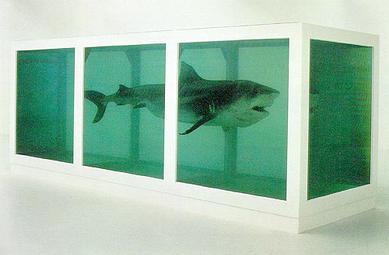
Hirst gained notoriety with his now equally infamous formaldehyde Shark that was exhibited at the Met a few years back, which was the winning piece in Hirst's repertoire.

Equally provocative was Tracy Emin's "My Bed" piece, exhibited at the Tate gallery in 1999 and also on the short list for the Turner. The work gained much media noteriety due to the presence of the bodily secretions in the bedsheets as well as items with other objects equally provocative ( undewear with menstrual blood, used condoms, etc). Although it did not win the prize it is representative of work constantly evaluated as a potential winner.

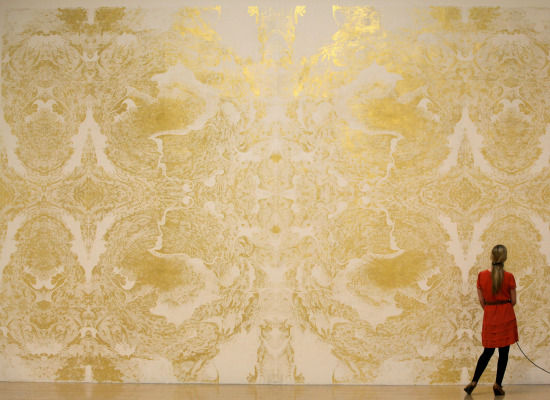
This year's winner is Richard Wright, who won the Prize with a gold fresco presented at the Turner exhibit as one of the official entries vying for the prize. The Guardian has published this article of the winner and his winning piece. The golden leaf fresco below was this year's winner. Sometimes the classics never runs out of style.

Named after the controversial romantic landscape painter J.M.W. Turner, the prize has often lived up to it's infamous namesake. Although widely recognized as one of the greatest masters if British watercolor, Turner's provocative paintings fused elements of humanism and it's vulnerable and vulgar sublimity in natural world.
In Hannibal Crossing the Alps, this distinctive juxtaposition is clearly intended:

With this in mind it is no wonder that work as complex and provocative like the emotional sculptures (the one below is called "Virgin Mother") of Damien Hirst who was a winner in 1995 are just the type of work that Turner Prize winners often exhibit.

Hirst gained notoriety with his now equally infamous formaldehyde Shark that was exhibited at the Met a few years back, which was the winning piece in Hirst's repertoire.
Equally provocative was Tracy Emin's "My Bed" piece, exhibited at the Tate gallery in 1999 and also on the short list for the Turner. The work gained much media noteriety due to the presence of the bodily secretions in the bedsheets as well as items with other objects equally provocative ( undewear with menstrual blood, used condoms, etc). Although it did not win the prize it is representative of work constantly evaluated as a potential winner.

This year's winner is Richard Wright, who won the Prize with a gold fresco presented at the Turner exhibit as one of the official entries vying for the prize. The Guardian has published this article of the winner and his winning piece. The golden leaf fresco below was this year's winner. Sometimes the classics never runs out of style.
On the Silver Screen- Reflection from The New Yorker
Well, we're back after a long pause caused in part by a four day trip to the windy city, which was not as windy as I expected but it was as cold. Unfortunately, NUTA was not able to visit the many cultural offering that the city had to offer, yet we are sure that it won't be our last time there.
Anyhow, one of my favorite weekly magazines (I must confess that I am not a subscriber anymore) is the New Yorker. Those of you who've had a chance to read The New Yorker know that it offers some of the best writing and investigative reporting out there. Their mid year fiction edition is one of the most anticipated issues for literature lovers everywhere and their regulator contributors are some of the most important figures around.
However, I've always felt that their movie reviews have not always been their strongest feature and it's usually the third or forth option when I am looking to read a bit into a film I am about to watch. Still I found this article in their movie blog about some of their favorite movies of the year. I found four films in the list that I personally like and some options that surprised me, including the Wes Anderson film Fantastic Mr. Fox, which NUTA reviewed last week. So take a look at the article and try to catch some of them before the year is over.
The New Yorker's: The Ten Best Films of 2009
Disney's Up!

The highly rated Up In The Air!

An anti Twilight Kristen Stewart in the melancholic indie sleeper Adventureland

Anyhow, one of my favorite weekly magazines (I must confess that I am not a subscriber anymore) is the New Yorker. Those of you who've had a chance to read The New Yorker know that it offers some of the best writing and investigative reporting out there. Their mid year fiction edition is one of the most anticipated issues for literature lovers everywhere and their regulator contributors are some of the most important figures around.
However, I've always felt that their movie reviews have not always been their strongest feature and it's usually the third or forth option when I am looking to read a bit into a film I am about to watch. Still I found this article in their movie blog about some of their favorite movies of the year. I found four films in the list that I personally like and some options that surprised me, including the Wes Anderson film Fantastic Mr. Fox, which NUTA reviewed last week. So take a look at the article and try to catch some of them before the year is over.
The New Yorker's: The Ten Best Films of 2009
Disney's Up!

The highly rated Up In The Air!

An anti Twilight Kristen Stewart in the melancholic indie sleeper Adventureland

Tuesday, December 1, 2009
What Have You Been Reading Lately? The Year in Awards and Accolades
I'm a ritualistic reader of the Spanish newspaper El Pais. Their Culture section is very comprehensive when it comes to interviews with artists, writers and critics. The past two days I've been reading about Jose Emilio Pacheco, the Mexican poet who was awarded the Miguel Cervantes Prize in Spanish Literature and was curious to find out more about him and his work. If you are marveled by details of rhythm and frozen by the sublime beauty of words read this poem entitled Alta Tracion (High Treason)
Recently I had a debate with my good friend and Argentinean writer Eleonora Leone (small debate in which she won) about the validity of literary awards, what they mean, their political inclinations and overall agendas. At the end of our small debate, I concurred with her opinion that awards such as the Nobel in Literature have not always been given to the people that truly deserved them and surely not to some of the most spectacular writers in all of literature: Faulkner, Borges, Marcel Proust, James Joyce or even living legends like Mario Vargas Llosa or Philip Roth, just to name a few.
However some of the literary awards do shed compliment on some extraordinary writters and novels that would have remained in the dark if it was not for the prestige of receiving them (Junot Diaz comes to mind). Most importantly these awards enrich the curiosity of readers like myself who always long to discover writers and novels.
With this in mind I've put together a list of the most important literary prizes that come to mind, because as the old adage goes, Sharing is Caring:
Man Booker Award: Awarded each year for the best original full-length novel, written in the English language, by a citizen of either the Commonwealth of Nations, Ireland, or Zimbabwe.
2009 Winner: Hillary Mantel for Wolf Hall

Pulitzer Prize: Awarded since 1948 for distinguished fiction by an American author, preferably dealing with American life.
2009 Winner: Olive Kitteridge by Elizabeth Strout

National Book Award: Presented annually to American authors for literature published in the prior year.
2009 Winner: Column McCann for Let The Great World Spin

Pen Faulkner Award for Fiction: Awarded annually by the PEN/Faulkner Foundation to the author of the best American work of fiction that year.
2009 Winner: Joseph O'Neill for Netherland

Premio Miguel de Cervantes: Awarded annually to honor the lifetime achievement of an outstanding writer in the Spanish language.
2009 Winner: Jose Emilio Pacheco

Rómulo Gallegos International Novel Prize: Awarded to honor the work of the eminent novelist and also to stimulate the creational activity of the Hispanic speech writers.
2009 Winner: William Ospina for El Pais de la Canela

Premio Alfaguara: Awarded by the pretigious editorial house Santillana to an outstanding novel in the Spanish language.
2009 Winner: El Viajero del Siglo by Andres Neuman

Prix Goncourt: (France) Marie NDiaye for Trois femmes puissantes;
Strega Prize (Premio Strega):(Italy) Tiziano Scarpa for Stabat Mate;
Camões Prize (Portuguese, Prémio Camões): (Portugal) Arménio Vieira
Hope you found the list interesting, of course there are some awards that were not covered here and some incredible authors that even though were not mentioned in this list are also worth every single award here. We will cover some new writers and novels in a future entry.
Oh and yes I almost forgot:
Nobel Prize in Literature: Herta Müller

Recently I had a debate with my good friend and Argentinean writer Eleonora Leone (small debate in which she won) about the validity of literary awards, what they mean, their political inclinations and overall agendas. At the end of our small debate, I concurred with her opinion that awards such as the Nobel in Literature have not always been given to the people that truly deserved them and surely not to some of the most spectacular writers in all of literature: Faulkner, Borges, Marcel Proust, James Joyce or even living legends like Mario Vargas Llosa or Philip Roth, just to name a few.
However some of the literary awards do shed compliment on some extraordinary writters and novels that would have remained in the dark if it was not for the prestige of receiving them (Junot Diaz comes to mind). Most importantly these awards enrich the curiosity of readers like myself who always long to discover writers and novels.
With this in mind I've put together a list of the most important literary prizes that come to mind, because as the old adage goes, Sharing is Caring:
Man Booker Award: Awarded each year for the best original full-length novel, written in the English language, by a citizen of either the Commonwealth of Nations, Ireland, or Zimbabwe.
2009 Winner: Hillary Mantel for Wolf Hall

Pulitzer Prize: Awarded since 1948 for distinguished fiction by an American author, preferably dealing with American life.
2009 Winner: Olive Kitteridge by Elizabeth Strout

National Book Award: Presented annually to American authors for literature published in the prior year.
2009 Winner: Column McCann for Let The Great World Spin

Pen Faulkner Award for Fiction: Awarded annually by the PEN/Faulkner Foundation to the author of the best American work of fiction that year.
2009 Winner: Joseph O'Neill for Netherland

Premio Miguel de Cervantes: Awarded annually to honor the lifetime achievement of an outstanding writer in the Spanish language.
2009 Winner: Jose Emilio Pacheco

Rómulo Gallegos International Novel Prize: Awarded to honor the work of the eminent novelist and also to stimulate the creational activity of the Hispanic speech writers.
2009 Winner: William Ospina for El Pais de la Canela

Premio Alfaguara: Awarded by the pretigious editorial house Santillana to an outstanding novel in the Spanish language.
2009 Winner: El Viajero del Siglo by Andres Neuman

Prix Goncourt: (France) Marie NDiaye for Trois femmes puissantes;
Strega Prize (Premio Strega):(Italy) Tiziano Scarpa for Stabat Mate;
Camões Prize (Portuguese, Prémio Camões): (Portugal) Arménio Vieira
Hope you found the list interesting, of course there are some awards that were not covered here and some incredible authors that even though were not mentioned in this list are also worth every single award here. We will cover some new writers and novels in a future entry.
Oh and yes I almost forgot:
Nobel Prize in Literature: Herta Müller

Suburban Sexuality in the work of Eric Fischl
My very good friend Melissa, who is an industrial design major at the Pratt Institute in Brooklyn is a very reliable source to get your art right. Not because she is a connoisseur snob who would use the term avant garde like it was going out of style but rather because when you talk about art with her, she talks it how she sees it. Yesterday when I was trying to persuade her into writing a weekly post on art and design (her initial response was "I can't promise I'll do it every week") she texted me with a very interesting painter by the name of Eric Fischl, who is an American painter and sculpturer, considered by some as the godfather of modern realism.
Being the amateur aficionado of art that I am, I asked her what she liked about Fischl's work and her response was exactly what the non cognoscenti like myself want to hear; he's a realist painter with a Freudian complex. So I went "lurking" around the interweb in search of Eric Fischl and what I found fit exactly into the description of Melissa. Here is one of Fischl's famous painting entitled "Sleep Walking":

In this painting a young pubescent boy seems to be masturbating into a kiddie pool. It seems interesting to me the depiction of this act in such a strong manner, since it is Fischl's intent to provoke indignation at seeing what otherwise is an act that is common in sexuality. "The intention of Sleepwalker was not to offend but to shock an audience. Society weren’t so much shocked by the act of masturbation but rather the fact that it had been made public" wrote one critic. Interestenly so, the boy in this scene is somewhat unaware that he is being watched, either by us or perhaps by the voyeuristic Fischl. The shadow in the pool is perhaps the only indication that there are highlights set up for an act that this boy intended to be done at night and alone.
This cosmos of sexuality, voyeurism and emotional reaction seems to be the signature of Fischl's work. His depiction of everyday people in normal but not talked about situation often weight on issues concerning moral questions and psychodramatic reactions. Here is one of his famous and controversial pieces entitled "Bad Boy"

The setting again seems brilliant: this private/intimate moment, broken again by the voyeuristic. The light emanating quietly through the blinds. Has the young boy also stumbled unknowingly into this woman's room, just like the lights and the viewers are stumbling into this very same scene? Or he is also participating, suggestively like the fruits on the table? "He paints these great scenes that make you question what is really going on" said Melissa. Is this a painting about the loss of innocence or of the often private and exciting encounters with sexuality like in "Sleep Walking"? Crude or just normal? Human sexuality is the rawest of human needs anyway and at the end we are all active participants in its menage.
P.S. I will try to convince Melissa to write this post herself next Tuesday and later this week a post about Art Basel.
Being the amateur aficionado of art that I am, I asked her what she liked about Fischl's work and her response was exactly what the non cognoscenti like myself want to hear; he's a realist painter with a Freudian complex. So I went "lurking" around the interweb in search of Eric Fischl and what I found fit exactly into the description of Melissa. Here is one of Fischl's famous painting entitled "Sleep Walking":
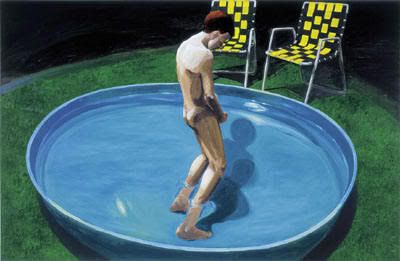
In this painting a young pubescent boy seems to be masturbating into a kiddie pool. It seems interesting to me the depiction of this act in such a strong manner, since it is Fischl's intent to provoke indignation at seeing what otherwise is an act that is common in sexuality. "The intention of Sleepwalker was not to offend but to shock an audience. Society weren’t so much shocked by the act of masturbation but rather the fact that it had been made public" wrote one critic. Interestenly so, the boy in this scene is somewhat unaware that he is being watched, either by us or perhaps by the voyeuristic Fischl. The shadow in the pool is perhaps the only indication that there are highlights set up for an act that this boy intended to be done at night and alone.
This cosmos of sexuality, voyeurism and emotional reaction seems to be the signature of Fischl's work. His depiction of everyday people in normal but not talked about situation often weight on issues concerning moral questions and psychodramatic reactions. Here is one of his famous and controversial pieces entitled "Bad Boy"

The setting again seems brilliant: this private/intimate moment, broken again by the voyeuristic. The light emanating quietly through the blinds. Has the young boy also stumbled unknowingly into this woman's room, just like the lights and the viewers are stumbling into this very same scene? Or he is also participating, suggestively like the fruits on the table? "He paints these great scenes that make you question what is really going on" said Melissa. Is this a painting about the loss of innocence or of the often private and exciting encounters with sexuality like in "Sleep Walking"? Crude or just normal? Human sexuality is the rawest of human needs anyway and at the end we are all active participants in its menage.
P.S. I will try to convince Melissa to write this post herself next Tuesday and later this week a post about Art Basel.
Subscribe to:
Posts (Atom)