Tuesday, January 7, 2014

Box Man

Imagine for a moment that you find yourself within the confines a very small box
and you find yourself derelict: in a near state of complete deterioration

Surprisingly you do not remember how you got here, how you managed to not only fit in this tiny box  but what incredible circumstances led you to abandon the remnants of your once normal existence and you begin to regress, slightly of course, since your memory is failing and more likely than not you are dehydrated and starved. 

You have made sure to find some blame, yourself first, consequently others, how you found yourself in this tiny box made of wood, you constantly ask?

There is not much noise coming from the outside world, not the familiar sounds of passing cars or wind running freely down the corridor of existence, there are no complaints from loved ones and colleagues or the smoky smell of left-over coffee pots.

You are suddenly terrified of your new found situation, of your restricted being, no longer the strong man you once thought to be or the vulnerable eccentric you often portrayed. 
There is no charm in suffocating on your own sweat, no place for nostalgia when survival is at stake. 

And just then you notice that your watch goes off, its alarm beeping incessantly and as you check the date unexplainably and absurdly you have been crouched in this tiny new world of yours for two months and three years, such a devastating discovery.

And you must tell yourself that you have lost your mind, that something is not right and then you blame someone again, anything obviously needs to blamed. 

And you scream, scream so loudly that your throat hurts of so much screaming and you’ve been screaming for hours and the world has forgotten about you and your wavy hair and your very nice clothes and the fancy luxury swiss watch you wave around and of your conquests, the big gargantuan ones and the small victories too.  

The world has forgotten of your diseases and your happiness and the great jokes you told in parties where some people had too much to drink and others just walked pass you unaware of your greatness. 

Now all is quiet, all too quiet, sleeping seems pointless and thoughts do too of course, what use for words if there is no one to speak them to and you realize how much you miss talking, the sounds of vowels and consonants frolicking together and the cadence by which you were so well identified. 

Someone must miss it you tell yourself and upsetting your mood you have now neglected your momentary joy as you remember that your watch says that in such a long time no one has dared to pry open the confines of this terrible box and lift you out and say out loud scream with joy: you old geezer you! oh how we’ve missed you! please tell us about your funny times, about your travels and memories, about your sexual adventures, we want to hear more! 


No one is asking questions anymore. Imagine the confines that you have become. Resigned you must now reinvent yourself. 

Monday, January 6, 2014

Five Continued Stories After Two Years of Snow

An Ode to Noise Surrounding the Palace

Returning home after a night too long of a story to tell
I find myself adrift in a midnight confession 
with the emptiness of my living room.
the furniture seem to breathe so loudly 
that I want to cough or make some sort noise to stop their obnoxious snoring

there are worse things that you can imagine at night in an empty quarters:
ghosts for example if you believe in such fairy tales;
thieves in black masks if you watch the news each night;
rodents and other insects polluting the inside of you walls;
WHY THE NEGATIVITY! screams out my worn-out futon
I can;t manage to agree more with it, the silent objects of have won the battle of reason once again

There ARE worst things in life than finding yourself alone in a tiny apartment, for one I try not think of them, I rather let the night take its mysterious course and teach me it's eerie lesson.


--------

A View from An Open Window
For Jose Paz & Amaru J. Sánchez

From a view where I am used to seeing open skies today a cloud of dusty rain looks like crumpled wrapping paper, the one you buy on sale when there is nothing left at the store and you are in quick need of a present wrapper.

I'm anticipating more excitement than usual for this not yet rainy day, I haven’t had an afternoon this somber since the passing of my grandfather many years ago.

Gloomy as all may seem the silver linings strings from afar form a quick halo of what some might consider opportunistic hope, all of this misleading in a very cruel way. Who can tell for sure what the weather means on days like these

Jets forming distant parachutes of cloudy smoke cruise ever so gently over the graying sky with almost jazzy conspicuousness in its regal eminence.

I could be used to other views this time of the year, some of them brighter, some of them less sunny, other views would soar my belly with the air of a hot ballon ready to ascend into the blue firmament: not so easy and other times not so hard to explain.

Nevertheless, I am prepared to weather the storm.

-------

Hair Just Above

Into my woman’s arms I fall carelessly in the middle of it all,
it doesn't matter what it means, or what the papers say,
strong currents in the sea don’t mean much in her embrace.

I could run and run as far as I can, never too far from her grazing scent from the blooming of her red rose, the pearl of my insolent soul.

I do not know why or when or how, but I am deeply in love with the tiny hairs that adorn her abdomen, invisible only until I am close enough to kiss her with only air.

Time has gone by now and my arms not yet tired have been roaming through the rumble that his her silk, how else can I describe her skin?

No one likes to leave a warm bed undone, messy, filled with whispers, filled with somnolence and those tiny expectations that something among lovers is always new.

---------

O.

I’ve been expecting rain to fall, I’ve been expecting rain to fall,
I can't say it any louder, my god I’ve been expecting rain to fall.
Here comes some sunshine bathing my skin, closing my eyes,
robbing my face of a cool breeze, cruel and insipid sun I’ve been expecting rain to fall

I’ve been begging for forgiveness, I’ve been begging ceaselessly for forgiveness of any kind, in any shape and size, in small quantities, in timid whispers, in written letters, in long lasting dreams when I may not be really at fault, I cannot state it any truer I’ve been begging for forgiveness

I’ve walked this dusty path too far, I’ve walked it way too far, so far along that my footprints blend in with the grass behind and anytime now snow may start to fall, pain rushes down my knees into my bones,
I’ve walked this dusty path too far

And so I’ve arrived, way too early to expect a heartfelt welcome,
no one at the door to greet my opened arms, so I hug the wind,
and you know all too well that the wind does not hug back.

There are no loud welcomes, there are no salutary welcomes,
there are no laughing welcomes and of course no un-welcomes.
I can’t say loud enough, I've been begging for forgiveness.

-For the hurt and broken. For A.G.C.

---------


Old Friends Carry Sharp Knives

I will not carry in my hands any sharp objects,
long nails, puncturing items and resentful fingers.
I will not interject or interfere,
decide upon myself what is best of me,
that task is left to better judgement.
I cannot hold any longer to folded envelopes
stuffed with too much paper, too many pages and numbered scenarios.
I will not decide to swim steadily for fear of drowning ,
I will not own it up to my backward steps, to my lost smiles,
to my happy past or my miserable tomorrows,
I am not forthcoming in my old pupils,
in the nervous blinking, in my last diagnostics,
all my old trophies and third place medals will need to be recycled, devoid of existence,
for its own sake of belonging, of meddling with its own place in history.
I will not carry any more hot air, cold winter, overbearing radius,
I will no longer belong to myself,
something has to give to make me realize that all sharp objects cannot cut edges any longer.

Monday, May 23, 2011

The Element of Non-Surprise in Fellini's La Strada


There is an understated simplicity in Federico Fellini’s La Strada which resonates at times in boring monotony. This is not to say that this Italian masterpiece is anything near boring or monotonous, but rather reflective of the Neo-Realism present throughout Italian cinema at the time of the making of La Strada.

The fact that much of the film is a silent study of two characters facial and physical expressions, only lends more credibility to the feeling that these characters may still be roaming the roads of the post War World II Italian provinces with their everydayness and universality intact.

In a fantastic review by film credit Roger Ebert, the writer makes an observation that in all of Fellini’s films there are elements which obsessed the filmmaker throughout his career: a man suspended in the air, the seashore, a parade, clowns and prostitutes. These elements are woven masterfully into a timeless story of love and heartbreak and the intricacies of understanding everything else in between.

The bond between Zamapano, the travelling and brutish artist, and his dimwitted lover/assistant/conscious, is saddening and comical, repudiated by both at times and impossible to escape as well. Gelsomina, played to staggering perfection by the pantomime master Giulietta Masina, could not have spoken a single syllable in the entire films and the effect would have been the same: beautiful and freighting almost at once. Her comic timing is perfect, only balanced by the powerful expressions of fear and loathe that her facial features so effortlessly portray. With core simplicity all that Gelsomina expresses is all there is in her: genuine emotions she cannot hide making it seem like she is incapable of self reflection .Her companion/owner, Zampano, played with gusto by the Mexican American actor Anthony Quinn, is a disheveled mix of machismo, stubbornness and male insecurity. His physical characteristics: strong, tall, boorish, more than rough on the edges, deliver the needed morphology that will ultimately expose the human element that is hidden inside him throughout the story.


Both characters prove to be misleading at the films melancholic end in part to the volatile presence of the third character present in the film, The Fool, who’s constant pressings and teasing of Zampano, lead to his doom and in an ironic twist of unwanted fate, the endings of the other two characters as well. Three characters to dissect humanity in endearing and seemingly uncomplicated terms: a clueless and innocent soul, a hard headed and emotionally closed man and a clown, a buffoon capable of loving and destroying with equal ease.


Isn’t life so? The struggle between understanding one’s place in a hard and cruel place, trying to love and not receive love in return, or pretending not to and then asking for forgiveness and answers to unanswerable questions.
This symbiotic and emotional dystrophy present throughout this quietly deceiving film is a testament to its relenting reflection of everyday life: A man and his struggle to understand, sometimes beyond his own comprehension the cruel insistence of a quiet world surrounded by the absurd and the loving.

Sunday, August 29, 2010

The Many Past Lives of My Soul

Today NUTA brings you an interesting article borrowed from the New York Times about the rising interest of reincarnation.

Enjoy....


Remembrances of Lives Past


IN one of his past lives, Dr. Paul DeBell believes, he was a caveman. The gray-haired Cornell-trained psychiatrist has a gentle, serious manner, and his appearance, together with the generic shrink décor of his office — leather couch, granite-topped coffee table — makes this pronouncement seem particularly jarring.


In that earlier incarnation, “I was going along, going along, going along, and I got eaten,” said Dr. DeBell, who has a private practice on the Upper East Side where he specializes in hypnotizing those hoping to retrieve memories of past lives. Dr. DeBell likes to reflect on how previous lives can alter one’s sense of self. He, for example, is more than a psychiatrist in 21st-century Manhattan; he believes he is an eternal soul who also inhabited the body of a Tibetan monk and a conscientious German who refused to betray his Jewish neighbors in the Holocaust.


Read more.

Friday, August 27, 2010

In the eye of the beholder: Ursula Von Rydingsvard

Here's my very good friend Melissa Robelo Salazar on German sculptor Ursula Von Rydingsvard, one of her personal favorites:

Ursula's work is very organic and gestural. Her manipulation of the material and form give the sculptures an emotional aesthetic.


Each sculpture seems to have its own history... its own story, and she achieves this by manipulating the cedar to create texture and form.


At glance you wonder if these were not part of some natural landscape? But then you realize they're not... They're the result of an arduous artistic process.

-Melissa Robelo Salazar is an industrial design student at the Pratt Institute in Brooklyn and an occasional contributor to this blog.

Thursday, August 26, 2010

Check Out This Blog Dude: Oceanic Dreams

Felix Leander has been swimming with the fishes since he was a child. His passion is not restricted only to the aquarium varieties, but also includes some of the most feared (unjustifiably so) animals in the vast blue sea. He has been blogging about diving with Sharks for a many years and thru his advocacy he's convincing people to turn around their negative perceptions about these intriguing and beautiful creatures. If there's anyone that can separate fact from myth, it's this real life conservationist Aquaman.


His blog, the educating and charmingly titled, Oceanic Dreams, is a meeting point for Shark Lovers of all walks of life. Among the incredible pictures, which he often takes himself while diving with his father Wolf Leander, there's also a diverse range of articles compiled from different blogs, magazines and newspapers across the websphere, including my personal favorite yearly analysis of the highly popular Shark Week series broadcast every year by Discovery Channel.

Here's Felix on feeding Sharks:

To feed or not to feed- that is the question

While I have only occasionally offered a shark a fish carcasse, I normally caress sharks as gently as possible, and never hold on to a fin to get a ride or perform stunts for others.

I am very well aware that touching sharks or other wild animals is debatable, and not everybody accepts my explanation that when I feel attracted to a being, human or animal, I just have the urge to stroke it. Thus, touching a shark is to me no more than a tactile expression of love.

One shark diver who would never interact closely with large tiger sharks, and saw me doing it a few times, has not only gone beyond touching tigers, but keeps hand-feeding them to see how far he can push the envelope to impress fellow divers and especially marveling media folks.

All I can say is that hand-feeding a tiger shark is neither difficult (potentially dangerous - yes) nor necessary. I have decided to quit doing it, also in order to not put my dive shark operator in a compromising position should anything bad happen.

Here is a blog with a magazine article on the subject I find not only very well written but highly informative and as balanced as any report on such sensitive issue can be.


-----

You can read more of Felix's blog by clicking here.

-NUTA

Monday, August 23, 2010

A Genre-Free Band: ARBOLES LIBRES


Not to make any comparisons, but the first time I met Nacho, singer, guitarist and chief agitator of the genre-free band Arboles Libres, I immediately thought of Nacho Vegas. Obviously the name made the first connection, but then armed only with a guitar and a harmonica, there was something strangely fresh about what until that moment I believed was a folk singer-song writer.

Two years later my friend Alejandro Angee is playing with his band Minimal at Transit Lounge in downtown Miami. I run into Nacho and after a few minutes of disparate and banal small talk I begin to tell everyone within earshot that "this guy is a Spanish Bob Dylan, a more melodic Latin American Leonard Cohen". Nacho laughs of course- "no man, wait till you hear what we do now" he says somewhat mischievously.

The night progressed and me and a group of 5 friends are downing Jameson shots and Sierra Nevadas like drunk twenty somethings with nothing better to do: the backyard of Transit Lounge is packed with indie music scenesters, Brickell kids wanting to escape the "boom boom" of the bars on 10th St and a few fiftysomethings who may or may not be the parents or music teachers of the excellent musicians on stage. After Alejandro's set is over, I high five him for an always "too cool" set. I mention to him briefly that I ran into "that dude Nacho who played in that fundraiser we did a few years ago" and Alejandro who is basically my wikipedia on all things Miami indie scene says: "oh yeah, wait till you hear what they do now".


I'm already hyped up. "Well what the hell do they do?" I ask Jose who ignoring me answers- "nothing man, they serve drinks, that's all they do" -as he looks at the two bartenders passing around Jack and Coke, his eyes transfused into either their lower backs or the bottle openers hanging from their black shorts. "What?" I say befuddled by his ignorant indifference "You have no idea what your about to experience" I brag, restrained only by my sudden realization that, 1) I've perhaps drank too many Sierra's and am at that point where everything excites me too much or makes me too sad and 2) I have no idea what Arboles Libres sounds like either.

Here's the thing, if you were to judge by the company that the three members of Arboles Libres keep, you would think that these guys are drug-infused-take-it-or-leave-it rock stars. There are model skinny girls in model skinny tights, guys with mustaches so voluminous that it defies description and they all circumvent them like they were planning something bad, very bad and that bad (meaning badass) was about to explode on stage.

I took my place near the front of the crowd when it was time for them to come. The backyard of Transit where the outside stage is located, began to resemble a pentecostal gathering as people bunched up, tightening open spaces, trying to get a close glimpse, on the far right of the stage, a group of girls, who were not part of the Arboles Libres pose waited for their boyfriends to bring them drinks, refusing to lose their space. I found friends standing a handful of people behind me still taking shots and looking at the bartenders. "Forget them, I'm ready to rock" I thought, unusually euphoric.

What came out of those two guitars and that hard hitting drum set can only be described as "sweet acidic melody". Bodies began to drag, seduced first by the ferocious riffs and hard hitting base of the drummer. "Mars Volta" I thought immediately, no comparisons needed: a minute into the first song the entire floor had transformed itself once again: bodies shaking, shimmering, convulsing, moshing, dancing, I could swear I saw a guy praying. Immediately I was regressed almost a time when I first discovered rock and roll in its strangest, rawest, most visceral and beautiful form.

Hey old Nacho, no need to go back to that old harmonica, "wait till you hear what you do now"

Here's a video from Arboles Libres, which is the way you should always see them:


And here's a video of MINIMAL, Alejandro Angee's phenomenal band:


All art in this post belongs exclusively to Arboles Libres.


-NUTA

A Veces Extraño el Humo


el humo que se escapa mientras fumo
perece un torero desesperado
a quien el toro lo acecha
a quien el viento lo atormenta.

forma simbolos mientras se exilia:
una nube blanca me dice adios
y ya comienzo a extrañarla

otras veces y sin verguenza
se reune en mi nariz a titubear
y me acaricia los ojos:
maliciosamente
dejandome un beso ardido en los parpados

A Writer You Should Know (& read) About: Daniel Alarcon

In 2007 I had the privilege of assisting to a reading by three up and coming young authors. It took place during the Miami Book Fair Internation, which is hosted every year by Miami Dade College. Without knowing and I must say that it happens to me quite often, I was listening to an artist who would soon explode into the literary world as one of the young promises of contemporary Latin American writers.

The panel was titled "39 under 39" or something of that kind, the reference being a showcase of the 39 most exciting and promising young writers under 39 years of age. I do not remember the names of the two other writers, although I believe one of them was a young and attractive Cuban American woman and the other may or may not have been a Mexican writer. However, Daniel Alarcon stood solidly in my mind, especially the uncanny title of his book: "Lost City Radio". So much it stuck that a few months later when browsing through the Spanish section of a book store trying to find the book I found out that my chances of finding a copy of Alarcon's debut novel were little to none. Not because they were not published or the run was too limited for distribution, but rather because his novel, Lost City Radio was written, edited and published in English.


Alarcon, a Peruvian born Californian was named this past summer in The New Yorker's 20 under 40 list of the best writers that have not reached the four decades of existence. His writing is natural and refreshing, with a tone of universality that transcends languages, yet curiously familiar for young people who have lived in Latin American at any given time. Although, Alarcon emigrated to the U.S. at a very young age, raised and schooled in the U.S., the cultural ambiance of his writing and the vivid depiction of Latin American ethos is so palpable that it is not lost in translation.

Here is a short story published in the August 16th issue of The New York titled "Second Lives"

For more on Daniel Alarcon and other young Latin American writers click here

Sunday, August 22, 2010

What is it about 20-Somethings?

A fascinating article about the art of growing up featured on this week's edition of the New York Times Magazine.

This question pops up everywhere, underlying concerns about “failure to launch” and “boomerang kids.” Two new sitcoms feature grown children moving back in with their parents — “$#*! My Dad Says,” starring William Shatner as a divorced curmudgeon whose 20-something son can’t make it on his own as a blogger, and “Big Lake,” in which a financial whiz kid loses his Wall Street job and moves back home to rural Pennsylvania. A cover of The New Yorker last spring picked up on the zeitgeist: a young man hangs up his new Ph.D. in his boyhood bedroom, the cardboard box at his feet signaling his plans to move back home now that he’s officially overqualified for a job. In the doorway stand his parents, their expressions a mix of resignation, worry, annoyance and perplexity: how exactly did this happen?

It’s happening all over, in all sorts of families, not just young people moving back home but also young people taking longer to reach adulthood overall. It’s a development that predates the current economic doldrums, and no one knows yet what the impact will be — on the prospects of the young men and women; on the parents on whom so many of them depend; on society, built on the expectation of an orderly progression in which kids finish school, grow up, start careers, make a family and eventually retire to live on pensions supported by the next crop of kids who finish school, grow up, start careers, make a family and on and on. The traditional cycle seems to have gone off course, as young people remain un tethered to romantic partners or to permanent homes, going back to school for lack of better options, traveling, avoiding commitments, competing ferociously for unpaid internships or temporary (and often grueling) Teach for America jobs, forestalling the beginning of adult life.

The 20s are a black box, and there is a lot of churning in there. One-third of people in their 20s move to a new residence every year. Forty percent move back home with their parents at least once. They go through an average of seven jobs in their 20s, more job changes than in any other stretch. Two-thirds spend at least some time living with a romantic partner without being married. And marriage occurs later than ever. The median age at first marriage in the early 1970s, when the baby boomers were young, was 21 for women and 23 for men; by 2009 it had climbed to 26 for women and 28 for men, five years in a little more than a generation.

We’re in the thick of what one sociologist calls “the changing timetable for adulthood.” Sociologists traditionally define the “transition to adulthood” as marked by five milestones: completing school, leaving home, becoming financially independent, marrying and having a child. In 1960, 77 percent of women and 65 percent of men had, by the time they reached 30, passed all five milestones. Among 30-year-olds in 2000, according to data from the United States Census Bureau, fewer than half of the women and one-third of the men had done so. A Canadian study reported that a typical 30-year-old in 2001 had completed the same number of milestones as a 25-year-old in the early ’70s.

The whole idea of milestones, of course, is something of an anachronism; it implies a lockstep march toward adulthood that is rare these days. Kids don’t shuffle along in unison on the road to maturity. They slouch toward adulthood at an uneven, highly individual pace. Some never achieve all five milestones, including those who are single or childless by choice, or unable to marry even if they wanted to because they’re gay. Others reach the milestones completely out of order, advancing professionally before committing to a monogamous relationship, having children young and marrying later, leaving school to go to work and returning to school long after becoming financially secure.

Even if some traditional milestones are never reached, one thing is clear: Getting to what we would generally call adulthood is happening later than ever. But why? That’s the subject of lively debate among policy makers and academics. To some, what we’re seeing is a transient epiphenomenon, the byproduct of cultural and economic forces. To others, the longer road to adulthood signifies something deep, durable and maybe better-suited to our neurological hard-wiring. What we’re seeing, they insist, is the dawning of a new life stage — a stage that all of us need to adjust to.

JEFFREY JENSEN ARNETT, a psychology professor at Clark University in Worcester, Mass., is leading the movement to view the 20s as a distinct life stage, which he calls “emerging adulthood.” He says what is happening now is analogous to what happened a century ago, when social and economic changes helped create adolescence — a stage we take for granted but one that had to be recognized by psychologists, accepted by society and accommodated by institutions that served the young. Similar changes at the turn of the 21st century have laid the groundwork for another new stage, Arnett says, between the age of 18 and the late 20s. Among the cultural changes he points to that have led to “emerging adulthood” are the need for more education to survive in an information-based economy; fewer entry-level jobs even after all that schooling; young people feeling less rush to marry because of the general acceptance of premarital sex, cohabitation and birth control; and young women feeling less rush to have babies given their wide range of career options and their access to assisted reproductive technology if they delay pregnancy beyond their most fertile years.

Continue reading here

Saturday, August 21, 2010

Racist White Ladies Say the Darnest Things!


It's just a matter of perception right? Is this glass half full or glass half empty? With most situation it always is: Is that IPad really worth it's price considering that you already own a laptop, an iphone and a desktop! Some would argue that being technologically up to date is an easy substitute to any financial inconvenience that an $800 oversized iphone may cause to your wallet, and in the long run, the social and personal advantages will outweigh the initial cost.

Perspective, such an overused cliché, so overused that today in the CHATTER BOX we will be highlighting the not so "it just depends which angle you look at it from" incident of Dr. Laura Schlessinger. If you're not familiar with Dr. L, and there is no shame in not being familiar with her, she is a nationally syndicated radio host, who is lagging just behind the adorable Rush Limbaugh as the staple of American Conservatism on the airwaves. Recently Dr. L, has gotten in trouble for repeatedly using the "N WORD" live during a broadcast of her show which according to media reports brings in about 8 million listeners each week.
During an exchange with a caller who wanted advice from the good doctor on how to deal with the racial insensitivities of her husband's friends, the caller who identified herself as African American, outlined a series of inappropriate scenarios that made her feel uncomfortable. Dr. Laura interpreted the callers angst as nothing more than racial hypersensitivity questioning the usage of the N WORD by rappers and black comedians in TV and popular culture as she went on a long rant about the double standard of allowing African Americans to use the word out in the public, while castrating the use of the same word by non-blacks, i.e. her self during her own talk show.

Here are two clips of the exchange:


Dr. Laura, went on to accuse the caller, who was reaching out to her for advice and emotional closure of blowing the situation out of proportion, that questions about another person's culture are not signs of racism. Instead she argued that African Americans in the U.S. often depict non-blacks as racist with the smallest instance of what may be considered offensive.
Fine, the point is taken as valid only if Dr. Laura had not uttered such non-sense as "Some People are Just Hyper-Sensitive", "you listen to some Bl-ah-ck comics and all you hear is is N*&*^, if anyone without enough melanin says it its a horrible thing" and "If you're so hypersensitive about racism don't marry out of your race". Spicy right?

Since the incident she has gone on a public relations campaign to clear the issue, even though this is not the first time she has to do so: in the past she has accused homosexual men of being child predators. Not surprisingly so, her apology is not for being wrong but rather for ticking people off in the wrong way, kind her way of saying, it's just a matter of perspective kids!. Here's Slate commenting about it and NPR's take on the issue. She claims that people are on a crusade against her for speaking her mind and that she wants her First Amendment Rights back. Ah Dr. L you're so silly!

So here's my point, Dr. Laura, if you're so hypersensitive about you're First Amendment Rights Don't Go on Racist Rants on the airwaves, you knew as you uttered the N word a dozen times that your bosses and your sponsors were going to start calling you and you knew that the civil rights organization where going to call for a boycott of your show, what you didn't seem to know, because you are blinded by the veil of racism and ignorance, is that that particular word that you were so fond using during your show, is socially accepted to be used only by "blacks" because it belongs to their Moral Ammendments, because the instance of anyone else using it conjures historical memories of racism and slavery, which if you were not up to date, was abolished many many years ago. But furthermore, this is not an issue of your First Amendment Rights, no one is saying you cannot use the word, ask your cousins and uncles at those White Supremacist protests in D.C. during the summer, it is an issue of common sense, which you're not excused from because you have a Ph.D in Psysiology. You see Dr. L, unlike you, many people do care about other's sensitivities, thats why the holocaust is not an open topic of conversation with Jewish people, or Apartheid is not a colorful subject with South Africans, it's call empathy Doctor, and the First Ammendment is not an excuse for you not to have it.

NUTA

Friday, August 20, 2010

The Resurrection!

And we're back. After a very very long break, No U Turns is back on the interweb. During this long period of meditative transition, NUTA will be going through a small but necessary surgical procedure. While NUTA will not lose it's intended contextual nature, it will accommodate itself to offer better content and enhance it's visual appeal. With this in mind, we present the following schedule:

Mondays: Don't Turn that page: Authors and Books
Tuesdays: Turn the Music Up (kind of self explanatory)
Wednesdays: Read This Blog Dude.
Thursdays: In the Eye of the Beholder, artistic considerations.
Fridays: What a Cliche! A look at popular culture
Saturdays: The Chatterbox Room, a weekly discussion of fresh topics
Sunday: And on the 7th Day he rested, views on religion and spirituality

This said, NUTA's goal is to increase it's readership from 4 (thanks Felix, Amaru and those two other icons without pictures in them) people to about 100 by the end of September, however this will not be possible without the help of... well you.

Ok, so enough self therapy and let's get to work!

NUTA

Thursday, March 25, 2010

Food for your mind

Here are two great podcasts I recommend to anyone interested in listening to some fresh alternatives to the usual chatter on Public Radio.

The first is a gem of a podcast called Entitled Opinions hosted by Robert Harrison, professor of Italian Literature at Stanford and a scholar on Dante. If you are familiar with Fresh Air on NPR and have a tendency toward listening to a host interviewing of bevy of personalities, this is the equivalent of Fresh Air for the literati crowd. His Q&A's with contemporary thinkers, writers and intellectuals range from energetic debates on French Existentialism to Irish Poetry, American Fiction and Historical Theology. He is completely informative, with a full depth of ideas and gravitas on most subjects that he covers. While the topics can somewhat dwell a bit too long on academic lexicon for the most part if you are interested in energetic and thoughtful conversation this is the podcast for you.

The other one, a bit more known and recently profiled on a New York newspaper is the curiously wonderful In Our Time hosted by the legendary British broadcaster Melvyn Bragg. Most programmes feature a round table of experts discussing topics in themes ranging in Science, Arts, History, Religion and Contemporary Issues. Bragg, who is an Oxford man is usually surrounded by fellow Oxford scholars who with their expertise dissect a conversation so throughly that you will learn something new in every podcast, even in topics that perhaps you knew most about. I've been a listener of this pod for about two years and in the spirit of the old cliche, it never gets old.

Here are two podcasts I recommend from each program. Click on the title of the podcasts to access their websites and of course both podcast are available on Itunes.

Entitled Opinions:

Tobias Wolff on American Fiction

A conversation on Human Rights


In Our Time:

The History of History: How the writing of history through the years

Chance and Design: Exploring questions and theories of a grand design in the Universe.


-NUTA

Wednesday, March 24, 2010

A bit of local genius from a great mentor

Hello everyone, after a brief interlude for some reflection and redirection to my very young blog, No U Turs Allowed is back again up and running. I've been thinking about what to write and share on this space and serendipity has put in my way it's often intruding hands. My friend Johnny Bosche (who is also a writer) has posted on his Facebook account a poem by whom until today I realized was a mutual friend of ours. Ricardo Pau-Llosa is a poet, writer, professor and an authority on Latin American art. This incredible poem that Johnny posted is a sparkle of the way in which Pau-Llosa handles imagery and context into that mysterious force called poetry. Enjoy

Nicodemus Man

Imagine you are a predator
in a nature show on TV,
and your only food is a dying breed,
one of whose members is scrounging
in the snowy earth twenty feet away,
a den of its wrinkled pups waiting nearby,
and you are too hungry to consider
any change in the millennial menu,
and it is then, six feet from your lunge,
that the growl of your empty gut
betrays your position. But the prey
mothers on softly munching,
and it is clear she is deaf
and focused only on her hope,
and cannot notice you until
your jaw clamps and your claw tears,
and it is clear that God, your God,
has answered you.

For more on the poet visit his official website

Tuesday, December 8, 2009

The Not So Controversial Turner Prize 2009 Winner

The anticipated Turner Prize was awarded this week in the UK. For those of you not quite familiar with the prize, the Turner Prize for visual arts is a yearly award presented to a visual artist (it has been given to painters in the past, but it is usually associated with visual media) under the age of 50. The award is presented to the best piece of art work exhibited at the Tate Gallery during its annual Turner Prize exhibit.

Named after the controversial romantic landscape painter J.M.W. Turner, the prize has often lived up to it's infamous namesake. Although widely recognized as one of the greatest masters if British watercolor, Turner's provocative paintings fused elements of humanism and it's vulnerable and vulgar sublimity in natural world.

In Hannibal Crossing the Alps, this distinctive juxtaposition is clearly intended:


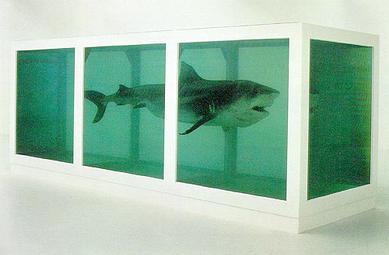
With this in mind it is no wonder that work as complex and provocative like the emotional sculptures (the one below is called "Virgin Mother") of Damien Hirst who was a winner in 1995 are just the type of work that Turner Prize winners often exhibit.


Hirst gained notoriety with his now equally infamous formaldehyde Shark that was exhibited at the Met a few years back, which was the winning piece in Hirst's repertoire.


Equally provocative was Tracy Emin's "My Bed" piece, exhibited at the Tate gallery in 1999 and also on the short list for the Turner. The work gained much media noteriety due to the presence of the bodily secretions in the bedsheets as well as items with other objects equally provocative ( undewear with menstrual blood, used condoms, etc). Although it did not win the prize it is representative of work constantly evaluated as a potential winner.


This year's winner is Richard Wright, who won the Prize with a gold fresco presented at the Turner exhibit as one of the official entries vying for the prize. The Guardian has published this article of the winner and his winning piece. The golden leaf fresco below was this year's winner. Sometimes the classics never runs out of style.

On the Silver Screen- Reflection from The New Yorker

Well, we're back after a long pause caused in part by a four day trip to the windy city, which was not as windy as I expected but it was as cold. Unfortunately, NUTA was not able to visit the many cultural offering that the city had to offer, yet we are sure that it won't be our last time there.

Anyhow, one of my favorite weekly magazines (I must confess that I am not a subscriber anymore) is the New Yorker. Those of you who've had a chance to read The New Yorker know that it offers some of the best writing and investigative reporting out there. Their mid year fiction edition is one of the most anticipated issues for literature lovers everywhere and their regulator contributors are some of the most important figures around.

However, I've always felt that their movie reviews have not always been their strongest feature and it's usually the third or forth option when I am looking to read a bit into a film I am about to watch. Still I found this article in their movie blog about some of their favorite movies of the year. I found four films in the list that I personally like and some options that surprised me, including the Wes Anderson film Fantastic Mr. Fox, which NUTA reviewed last week. So take a look at the article and try to catch some of them before the year is over.

The New Yorker's: The Ten Best Films of 2009

Disney's Up!


The highly rated Up In The Air!


An anti Twilight Kristen Stewart in the melancholic indie sleeper Adventureland

Tuesday, December 1, 2009

What Have You Been Reading Lately? The Year in Awards and Accolades

I'm a ritualistic reader of the Spanish newspaper El Pais. Their Culture section is very comprehensive when it comes to interviews with artists, writers and critics. The past two days I've been reading about Jose Emilio Pacheco, the Mexican poet who was awarded the Miguel Cervantes Prize in Spanish Literature and was curious to find out more about him and his work. If you are marveled by details of rhythm and frozen by the sublime beauty of words read this poem entitled Alta Tracion (High Treason)

Recently I had a debate with my good friend and Argentinean writer Eleonora Leone (small debate in which she won) about the validity of literary awards, what they mean, their political inclinations and overall agendas. At the end of our small debate, I concurred with her opinion that awards such as the Nobel in Literature have not always been given to the people that truly deserved them and surely not to some of the most spectacular writers in all of literature: Faulkner, Borges, Marcel Proust, James Joyce or even living legends like Mario Vargas Llosa or Philip Roth, just to name a few.

However some of the literary awards do shed compliment on some extraordinary writters and novels that would have remained in the dark if it was not for the prestige of receiving them (Junot Diaz comes to mind). Most importantly these awards enrich the curiosity of readers like myself who always long to discover writers and novels.

With this in mind I've put together a list of the most important literary prizes that come to mind, because as the old adage goes, Sharing is Caring:


Man Booker Award: Awarded each year for the best original full-length novel, written in the English language, by a citizen of either the Commonwealth of Nations, Ireland, or Zimbabwe.

2009 Winner: Hillary Mantel for Wolf Hall


Pulitzer Prize: Awarded since 1948 for distinguished fiction by an American author, preferably dealing with American life.

2009 Winner: Olive Kitteridge by Elizabeth Strout


National Book Award: Presented annually to American authors for literature published in the prior year.

2009 Winner: Column McCann for Let The Great World Spin


Pen Faulkner Award for Fiction: Awarded annually by the PEN/Faulkner Foundation to the author of the best American work of fiction that year.

2009 Winner: Joseph O'Neill for Netherland


Premio Miguel de Cervantes: Awarded annually to honor the lifetime achievement of an outstanding writer in the Spanish language.

2009 Winner: Jose Emilio Pacheco


Rómulo Gallegos International Novel Prize: Awarded to honor the work of the eminent novelist and also to stimulate the creational activity of the Hispanic speech writers.

2009 Winner: William Ospina for El Pais de la Canela


Premio Alfaguara: Awarded by the pretigious editorial house Santillana to an outstanding novel in the Spanish language.

2009 Winner: El Viajero del Siglo by Andres Neuman


Prix Goncourt: (France) Marie NDiaye for Trois femmes puissantes;

Strega Prize (Premio Strega):(Italy) Tiziano Scarpa for Stabat Mate;

Camões Prize (Portuguese, Prémio Camões): (Portugal) Arménio Vieira

Hope you found the list interesting, of course there are some awards that were not covered here and some incredible authors that even though were not mentioned in this list are also worth every single award here. We will cover some new writers and novels in a future entry.

Oh and yes I almost forgot:

Nobel Prize in Literature: Herta Müller

Suburban Sexuality in the work of Eric Fischl

My very good friend Melissa, who is an industrial design major at the Pratt Institute in Brooklyn is a very reliable source to get your art right. Not because she is a connoisseur snob who would use the term avant garde like it was going out of style but rather because when you talk about art with her, she talks it how she sees it. Yesterday when I was trying to persuade her into writing a weekly post on art and design (her initial response was "I can't promise I'll do it every week") she texted me with a very interesting painter by the name of Eric Fischl, who is an American painter and sculpturer, considered by some as the godfather of modern realism.

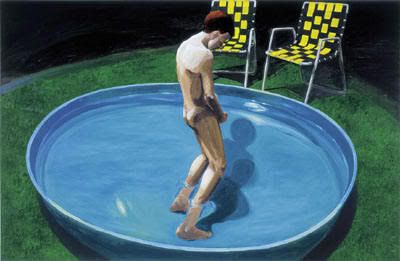
Being the amateur aficionado of art that I am, I asked her what she liked about Fischl's work and her response was exactly what the non cognoscenti like myself want to hear; he's a realist painter with a Freudian complex. So I went "lurking" around the interweb in search of Eric Fischl and what I found fit exactly into the description of Melissa. Here is one of Fischl's famous painting entitled "Sleep Walking":


In this painting a young pubescent boy seems to be masturbating into a kiddie pool. It seems interesting to me the depiction of this act in such a strong manner, since it is Fischl's intent to provoke indignation at seeing what otherwise is an act that is common in sexuality. "The intention of Sleepwalker was not to offend but to shock an audience. Society weren’t so much shocked by the act of masturbation but rather the fact that it had been made public" wrote one critic. Interestenly so, the boy in this scene is somewhat unaware that he is being watched, either by us or perhaps by the voyeuristic Fischl. The shadow in the pool is perhaps the only indication that there are highlights set up for an act that this boy intended to be done at night and alone.

This cosmos of sexuality, voyeurism and emotional reaction seems to be the signature of Fischl's work. His depiction of everyday people in normal but not talked about situation often weight on issues concerning moral questions and psychodramatic reactions. Here is one of his famous and controversial pieces entitled "Bad Boy"


The setting again seems brilliant: this private/intimate moment, broken again by the voyeuristic. The light emanating quietly through the blinds. Has the young boy also stumbled unknowingly into this woman's room, just like the lights and the viewers are stumbling into this very same scene? Or he is also participating, suggestively like the fruits on the table? "He paints these great scenes that make you question what is really going on" said Melissa. Is this a painting about the loss of innocence or of the often private and exciting encounters with sexuality like in "Sleep Walking"? Crude or just normal? Human sexuality is the rawest of human needs anyway and at the end we are all active participants in its menage.

P.S. I will try to convince Melissa to write this post herself next Tuesday and later this week a post about Art Basel.

Monday, November 30, 2009

Bon Iver or Let's Retire to the Countryside and Make Some Music

I have been talking about this guy the whole year: how he suffered countless life changing events that made him retire into the mountains of Maine to seek self recovery, how he only communicated with one person during his time in the cabin and perhaps most importantly how isolation, distress and mental suffocation gave birth to one of the most beautiful albums I have heard in a long time: For Emma, Forever Ago.
It's all there: it's beautiful imperfections (hisses, creaks, hollow echoes of sound), it's melancholic comfort, it's obscure optimism. Bon Iver (a variation of the french expression for "good winter") is the product of Justin Vernon a terrific musician formally of DeYamur Edison. Many of the people that I've recommended Bon Iver to, have been looping the song below in their ipods or their morning drive, I recommend you purchase the entire album ($9.99 on Itunes and even cheaper if you buy on LaLa, which is my favorite online musical store for independent music), pick a long and cool afternoon, settle quietly in your favorite place of comfort and find out for yourself why every major music critic was all over Bon Iver this year.

Saturday, November 28, 2009

A Fox on a Journey


In one of it’s key scenes, the main character in Wes Anderson’s first stop animation film “Fantastic Mr. Fox” suddenly asks his accomplice Possum friend, “Why a fox? I mean, why am I a fox and not a horse”. His possum friend, not a very bright fellow carelessly ignores the question, but Mr. Fox, the risqué hero of this engaging film, is entrenched in his own existential identity crisis throughout this wonderful and meticulous film about a family of Foxes, their community and the efforts of three farmers to get rid of all of them.
The film is an adaption of a children’s book by Roald Dahl and though the puppets that abound this tale could easily be found in any educational video for toddlers, this is a serious story about family, friendship and the search of one’s self.
That the story weighs heavily on questions of morality and the sometimes not-so-ethical decisions taken by its protagonist only provides the film with the serious gravity that its animated realm may disguise. Underneath the fur and shinny eyes of these animated actors there is an oeuvre of real life dilemmas that anyone who has ever felt a desire to find out who they are and what they are here for will immediately identify with.
After escaping a near death experience with his pregnant wife, Mr. Fox (George Clooney) decides that the way to go for the safety of his family is to retire from a career of chicken stealing and settle into a comfortable life as a newspaper columnist. His new life is dictated by his semi-famous published articles, (an item of uneasy insecurity since he is not convinced that many people actually read his column), a loving and artistic wife (Meryl Street) who’s body of work is to paint dazzling landscapes often ridden by thunderstorms, and a moody-angst ridden teenage son (Jason Schwartzman) constantly longing for his father’s approval.


After discussing his situation with his supporting wife (a brilliant dialogue where he talks about his aging life; he is 7 fox years old and nearing the end of his life) and considering the possibility of relocating somewhere more appropriate for his intended way of life (“I feel poor”, he tells his wife), Mr. Fox decides to move his family to a somewhat more affluent household against the advice of his attorney (Bill Murray) who is afraid that Mr. Fox will fall victim to three vicious farmers who will be his new neighbors. Yet where others see danger, Mr. Fox sees opportunity and he soon finds his way back to his old Foxy ways. What follows next is an uplifting, comic and witty examination of belonging to a family and consequently to a community while finding or perhaps not losing a part of one’s self in the process. Family dynamics are put to the test when Mr. Fox’s nephew, a precocious and naturally gifted teenager by the name of Kristofferson, moves in with the family, ensuing an ongoing competition for the attention of Mr. Fox by his teenage son and the new visitor.
As is the case with all children’s tale, the interaction between Mr. Fox and his farmer assailants is met with the levity that would make a children’s fable both entertaining and sufficiently clear for a child to understand, however, Anderson (The Royal Tennenbaums, Rushmore, The Life Aquatic with Steve Sizzou) packages such minute and dazzling details in the film, that such idiosyncrasies lend the film the appropriate gravitas that other films with human actors can only dream of.
Perhaps it is the combination of a fantasy animated world that disguise certain physical marks in the characters that make it somewhat more real when you see it coming from a puppet, or perhaps it is the tone of a completely fantastic world (the yellow tones that decorate the complete set are dazzling, hypnotizing and mood setting) which provides the story with the necessary realism to make you forget that your watching an animated feature.
No U Turns Allowed recommends Fantastic Mr. Fox as a must see film.